
Published on October 23, 2026
Modular shopping trolley: one system for different everyday needs
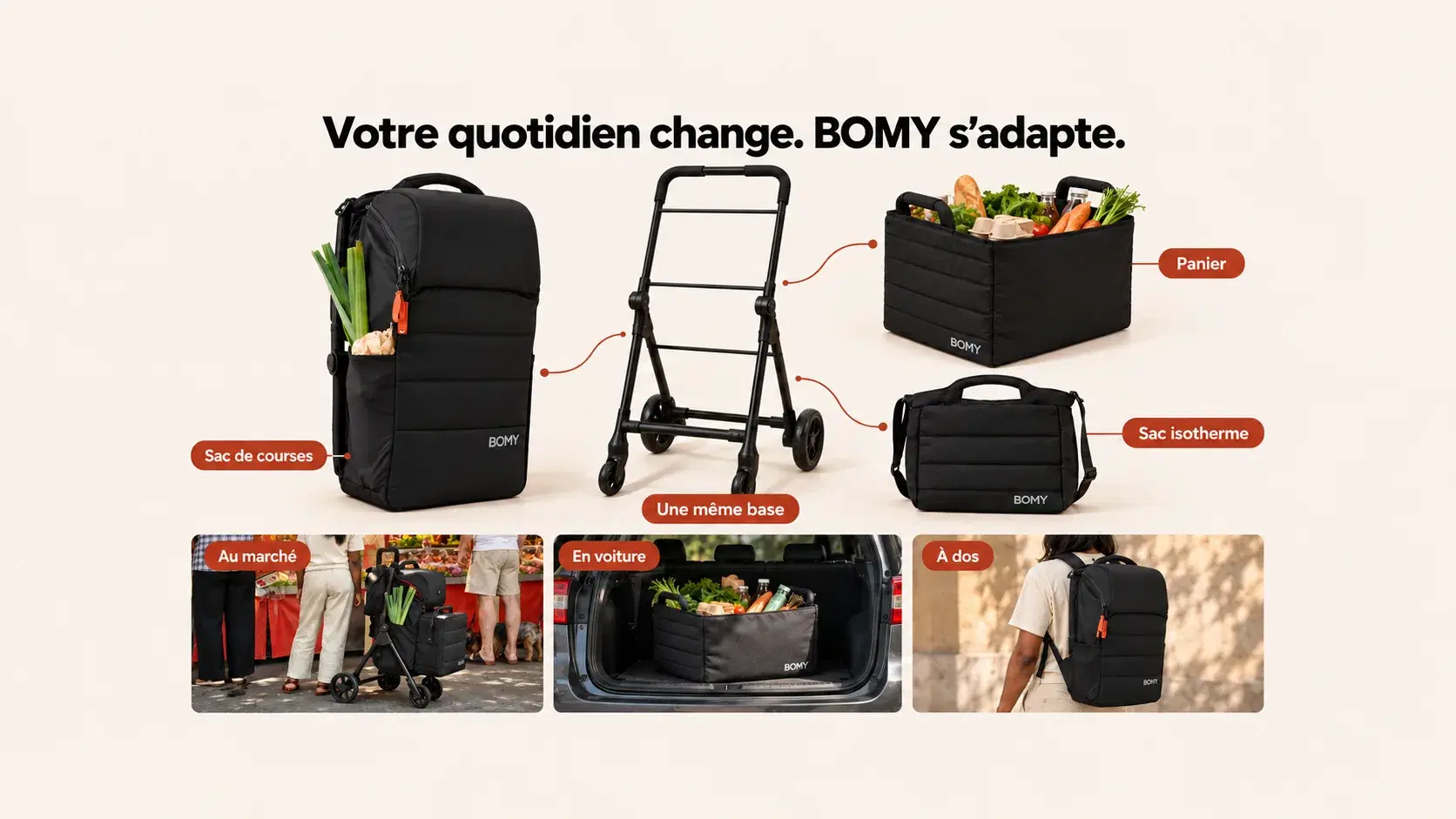
A market visit, a few purchases after work or the weekly food shop: do you always need the same equipment?
Buying guides generally recommend choosing a trolley around your habits. But what happens when those habits change from day to day?
That is BOMY’s starting point: one base, independent containers and different configurations to suit your routine.
1. Which capacity should you choose? Buying guides offer different answers
40, 50 or 60 litres: what capacity do you actually need?
Recommendations vary between websites:
5five suggests 20–30 L for top-up shopping and 40–50 L or more for family or weekly groceries.
TOC recommends around 30–40 L for smaller shops and 50–60 L for bulkier purchases.
Prévenchute suggests 40–50 L for one person’s weekly groceries, and 60 L or more for a couple or family.
The same capacity can therefore be recommended for different situations. How much you buy, how often you shop and the products you choose matter more than a universal size recommendation.
With BOMY, you can adjust your capacity instead of committing to one fixed volume.
2. What if your shopping needs change throughout the week?
Do you buy the same things at the local shop and the market?
In its article about choosing capacity around your lifestyle, Mon Chariot de Courses distinguishes regular fresh-food purchases from a family’s weekly shop.
Yet both situations can be part of your week.
With BOMY, you choose your setup:
11 L: the insulated bag on its own for a small chilled-food top-up.
45 L: one basket for trips where a single container is enough.
60 L: the shopping bag for a well-organised grocery shop.
71 L: the shopping bag with the insulated bag attached externally.
90 L: two baskets to divide a larger shop.
101 L: two baskets with the additional insulated bag.
That is the benefit of modularity: extra capacity when you need it, without taking everything on every trip.
3. Choosing a container also means choosing how you organise
Do you prefer dedicated compartments or keeping your purchases in full view?
The 5five guide highlights the usefulness of compartments and removable bags for organising groceries.
BOMY offers different ways to pack:
The shopping bag: dedicated spaces for delicate items and bottles.
Open baskets: a clear view of your shopping and the option to divide it between containers.
The separate insulated bag: chilled products kept apart from the rest.
You adapt both the space available and how you use it.
4. A different journey? A different way to carry
After leaving the shop, do you still have stairs, public transport or a car boot to deal with?
Prévenchute recommends considering your home, stairs, car journeys and storage space alongside capacity.
BOMY modules remain useful once unclipped:
The shopping bag becomes a backpack for the parts of your journey where you prefer to carry.
The baskets can be carried by hand to the car or into the kitchen.
The insulated bag travels independently, using its handles or shoulder strap.
One system can accompany different stages of your journey.
5. Modularity should stay simple, including when you put it away
Is changing your setup worthwhile if it takes a long time to assemble?
BOMY’s compatible modules use FIDLOCK fastenings, combining magnetic guidance with a mechanical lock to make attachment straightforward.
Once you get home:
The frame folds into three sections.
The shopping bag folds separately.
The baskets fold flat.
Store each element independently, then prepare the combination that suits your next trip.
With BOMY, choose a system that follows your habits
Buying guides offer useful starting points. Their differing recommendations also show why one capacity cannot describe every routine.
When your needs vary, modularity becomes a key advantage: change your capacity, organisation or carrying method around the same base.
With BOMY, you choose more than a product. You build a setup around your life.