
Published on October 9, 2026
Two or four wheels: should you pull or push your shopping trolley?
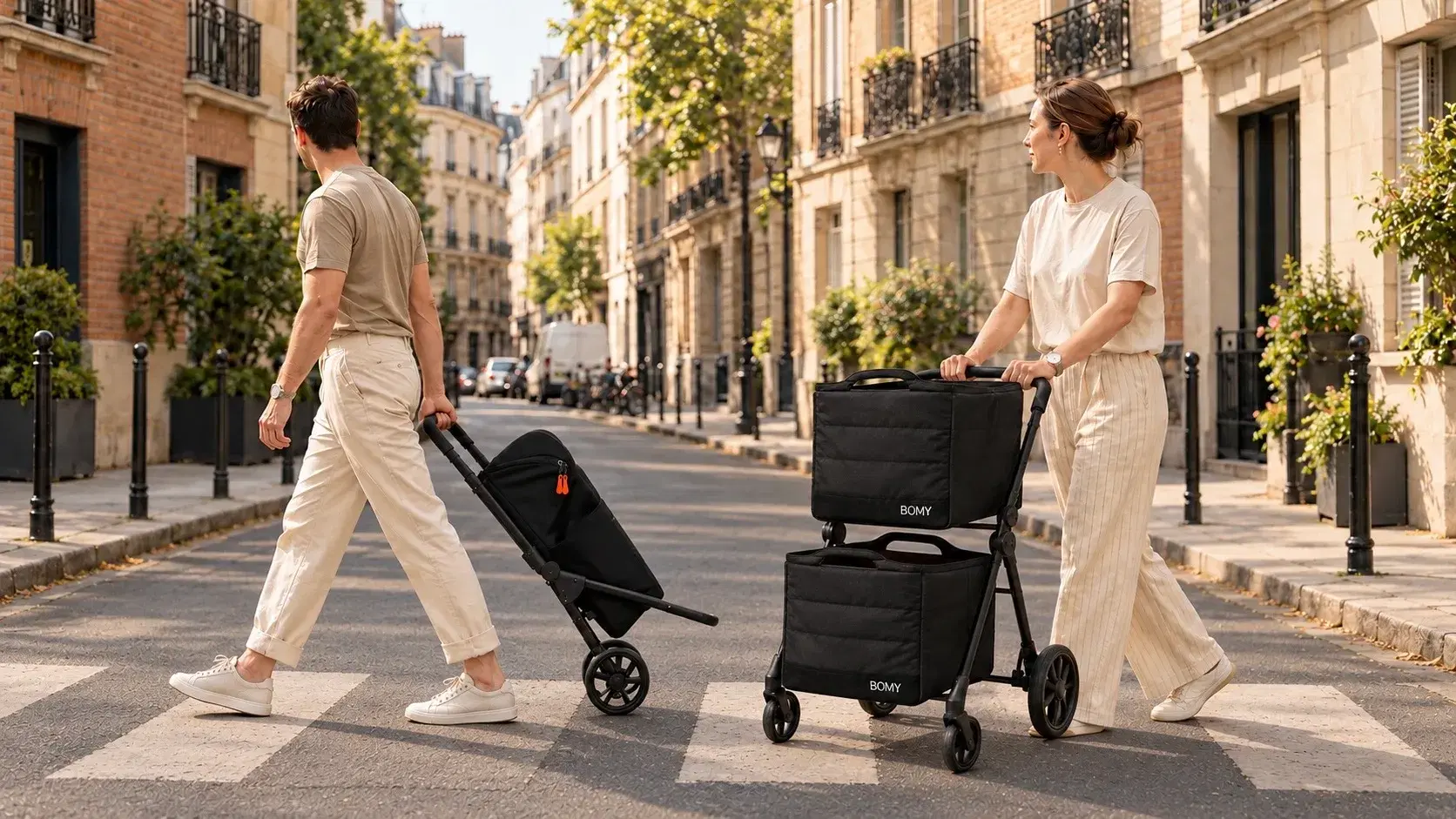
Do you walk to the market, navigating pavements and kerbs? Or do you mainly shop in supermarket aisles? The right shopping trolley starts with your everyday route.
Two wheels for pulling, four wheels for pushing: each configuration suits different habits. In its article “Are You Team Push or Team Pull?”, Roulette Carts also explores these two ways of carrying your shopping.
Three questions can help you choose:
What obstacles do you encounter ?
How do you want to move the load ?
How do you access your shopping ?
1. Two wheels: agility for everyday city journeys
Does your route include cobblestones, kerbs or uneven ground? Two large wheels can be a good fit.
Getting over obstacles: when tilted, the trolley rolls on its large wheels, with no small front castors to get over the kerb.
Following your route: you steer the trolley from its handle.
The trade-off: your hand keeps the trolley tilted and may support part of the load. How heavy it feels depends on how it is packed and balanced.
At BOMY, this is the thinking behind the Urbain and Urbain + packs: a two-wheel configuration with the shopping bag, designed for journeys on foot. The bag also unclips so you can carry it as a backpack whenever your route calls for it.
2. Four wheels: comfortable pushing on smooth surfaces
Do you mostly move through shop aisles or along smooth paths? Four wheels let you push your shopping while keeping the container in front of you.
Less weight to support: the wheels carry the trolley; you guide it without keeping it tilted.
Easy turns: swivelling front wheels help you manoeuvre through aisles.
The trade-off: small front wheels are more sensitive to holes, gaps and kerbs. Some obstacles require you to tilt the trolley onto its large rear wheels.
At BOMY, four-wheel configurations with baskets are designed around this experience: your shopping stays visible and accessible, with a familiar motion similar to pushing a supermarket trolley. A convenient setup for aisles and smooth surfaces.
3. Pushing or pulling: what does ergonomics tell us?
The Canadian Centre for Occupational Health and Safety recommends pushing rather than pulling whenever conditions allow.
A study published in Applied Ergonomics also found greater lower-back loading when pulling than when pushing in the situations tested (The research involved airline service carts).
The surface matters too. An experimental study by France’s INRS highlights how wheels, castors and floor surfaces affect the effort needed to get a trolley moving.
The key takeaway: four wheels reduce the weight you need to support in your hand, but the effort needed to move still depends on the load and the ground.
4. Which configuration suits your routine?
City journeys with regular kerbs: two large wheels and a shopping bag, as featured in BOMY’s Urbain packs.
Shopping in aisles on smooth floors: four wheels with baskets, so you can push and keep your purchases in view.
Different routines on different days: a system that can evolve with your needs.
With BOMY, your first choice can evolve
Your routine changes: a bigger shop, a new route, or simply the wish to switch from a bag to baskets.
BOMY’s modular design lets your setup evolve: move from two to four wheels with the conversion kit, switch compatible modules, carry the shopping bag as a backpack, or take the baskets by hand.
Choose what suits your habits today, with the flexibility to adapt tomorrow.